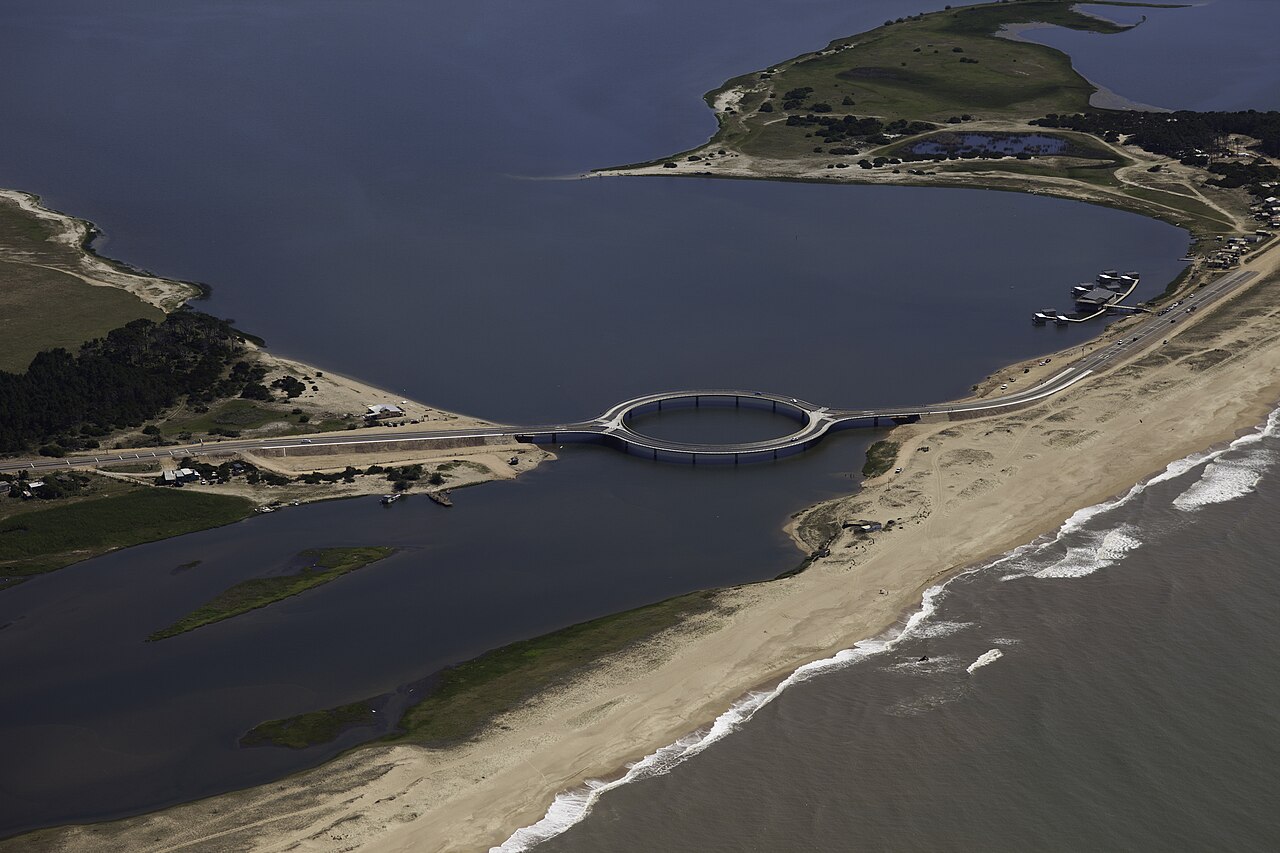
For a dog that has never seen the sea, the lagoon shore is a better starting point than the ocean coast: there is no shore break, the bottom shelves gently and the water warms up sooner. It is also where you have to look around the most, because it is a protected area with birds that nest straight on the sand.
The lagoon, keeping your distance from the wetlands
Laguna Garzón has been part of Uruguay’s National System of Protected Areas since 2014. The rules for visitors are few and common sense — do not go near nests or bird colonies, take your rubbish with you, stay on marked paths and permitted areas, keep vehicles on authorised roads — but with a dog the first one counts double: several species nest straight on the sand and a loose dog flushes them without meaning to. Lead on near the wetlands and the reed beds, and that is that.
The water is brackish: the lagoon opens to the sea when the sandbar breaks. Fine for cooling off, not for drinking. Bring fresh water and a folding bowl, and rinse the dog afterwards, because salt dries out the skin and ends in licking you would rather avoid.
One seasonal detail: the lagoon is a kitesurfing spot, with designated zones and windy hours. A kite coming down nearby frightens any dog. If there are kites on the water, walk somewhere else.
On the ocean side
In José Ignacio, the Brava breaks hard and is no place for a dog to get in the water, not even a strong swimmer: the rip current does not tell species apart. The Mansa is calmer and has long stretches to walk outside peak hours. La Juanita beach is the quietest of the three and the one that works best with a dog.
Several beaches around here have no lifeguards, or only in season. If there is nobody to help you, there is nobody to help your dog either. And in January and February the central beaches fill up: early morning and sunset are a different plan, with fewer people and cool sand.
What the by-law says
There is one rule worth knowing before you set foot on the sand: article 128 of decree 100/991 strictly forbids taking animals of any kind into designated bathing areas during the season. Each departmental government allows exceptions, and none of them is anywhere near: in Maldonado they are stretches of Mansa (stops 39 and 40) and Brava (25, 26 and 27) in Punta del Este, Balneario Buenos Aires, Piriápolis and the streams at Bella Vista; in Rocha, Playa del Faro and La Aguada in La Paloma and one access point in Barra del Chuy.
In practical terms: in season there is no dog-friendly beach between José Ignacio and the lagoon, so the sand with lifeguards and services is out. What is left — and it is most of the area — is the lagoon shore, the back roads and the stretches of coast with no designated bathing area, always with collar and lead and picking up after him. Off season the restriction does not apply. Reports of animals on non-authorised beaches are handled by the Coast Guard (4244 1967).
The sand burns
Between 11am and 5pm in midsummer, dry sand and tarmac can get hot enough to burn paw pads. The old test still works: press the back of your hand down for five seconds; if you cannot take it, neither can the dog. Shade, water and the edges of the day.
And one safety point worth keeping in mind in Uruguay: if the water looks greenish, murky or has a paint-like film at the edge, there may be a cyanobacteria bloom. That water is not for drinking or swimming, least of all for a dog, which dries itself by licking its coat.
After the swim, check between the toes: wet sand and salt irritate, and the grassland around here has ticks all summer. How to deal with it is in the health and emergencies page.