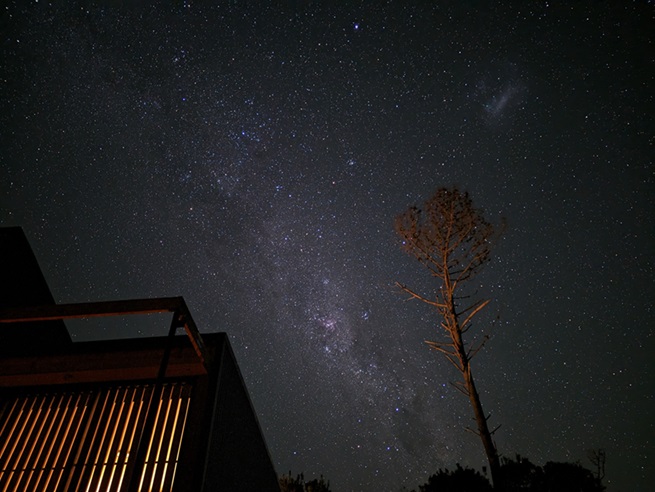
Can you take kids stargazing near Laguna Garzón? Yes — and it is one of the cheapest, most memorable outings in the area: all it takes is a clear night close to the new moon and a dark spot, on the La Juanita side or in the countryside around Pueblo Garzón, to see the Southern Cross, the Magellanic Clouds and the arc of the Milky Way with the naked eye. It usually works from about age 5 or 6, once children can sit still in the dark for a while, and anyone who would rather go with a guide can join a stargazing outing at El Caracol designed for families.
What to do
The plan is simple: arrive with the last light, let your eyes adjust and play at finding things in the sky. The first thing to appear looking south is the Southern Cross, four stars that work like a compass because they always point roughly toward the south celestial pole — the best starting point for kids, since they recognize it right away. Near it, on a really dark night, you can make out two patches of light that are not clouds but galaxies: the Magellanic Clouds, visible only from the southern hemisphere. And with no moon, the hazy band of the Milky Way crosses the sky; on September and October evenings its brightest stretch, around Scorpius, is still on show early in the night. The golden rule is patience: eyes take about 15 to 20 minutes to adapt to darkness, and any screen or white flashlight undoes that in seconds. With children it helps to turn that into a game — who spots a satellite first, who counts more shooting stars — and to bring binoculars, which are not essential but help with the Magellanic Clouds. The portal's stargazing guide explains the southern sky in detail.
Where
Darkness is what matters, and here it is only minutes away: move away from the lights of the circular bridge, the gas stations and the center of José Ignacio, and look for open ground with no tall trees or buildings blocking the horizon. The La Juanita side and the countryside around Pueblo Garzón, with dirt roads and little street lighting, usually offer darker skies than the beachfront. A combination that works well with kids is sunset at the bridge followed by a few minutes' drive to a spot with no lights. If you would rather go with a guide, the stargazing outing at El Caracol lasts three hours, starts at 4:30 pm — so it covers the transition from sunset to full dark — and is led by a schoolteacher and science educator; it is suitable for children and adults, requires booking via WhatsApp, and the price is published on its listing. On the same shore, Ecoturismo Laguna Garzón, at La Playita, Route 10 km 193, offers star nights all year with certified nature guides specializing in astronomy, and Discover Laguna Garzón adds full-moon outings and campfires. To sleep under that sky, the EcoGarzón glamping has domes and tents in the woods on the Rocha side.
When
The variable that matters most is not the season but the phase of the moon: near full moon its glare hides the faint stars and the Magellanic Clouds all but vanish; the days around the new moon are the best, in any month. This September the new moon falls on the 11th, so the week around that date is ideal; the lunar calendar changes every month, so check it before picking a night. The second requirement is a clear sky — without it there is nothing to see. Families get a bonus in September and October, when it gets dark early enough to fit the outing before the youngest children's bedtime; in summer you wait longer, but the weather tends to be more stable. In winter the same plan pairs well with a day of whale watching from the shore or birdwatching.
Tips for going with kids
Extra layers, always: sitting still at night near the water, the wind chill drops fast even in summer. A blanket or folding chairs to look up without straining necks, a thermos of something hot and a snack — the medialunas from Route 10 travel well — turn the wait into a picnic. Bring a red-light flashlight, or a regular one covered with red cellophane, so as not to break your eyes' dark adaptation; phones stay in pockets. In the warm months, insect repellent. Plan on 30 to 45 minutes of observing for the youngest, and choose a spot where the car is close and away from the road: the dirt tracks are unlit and have no sidewalks, so children walk hand in hand to the viewing point, and nobody goes near the shoreline in the dark. With the guided outing, capacity and start time are confirmed when you book; without a car, the José Ignacio taxis handle the ride back at night. If clouds roll in, the rainy-day plan for families saves the evening.
Spotted an error? Write to hola@portalgarzon.com and we will fix it.