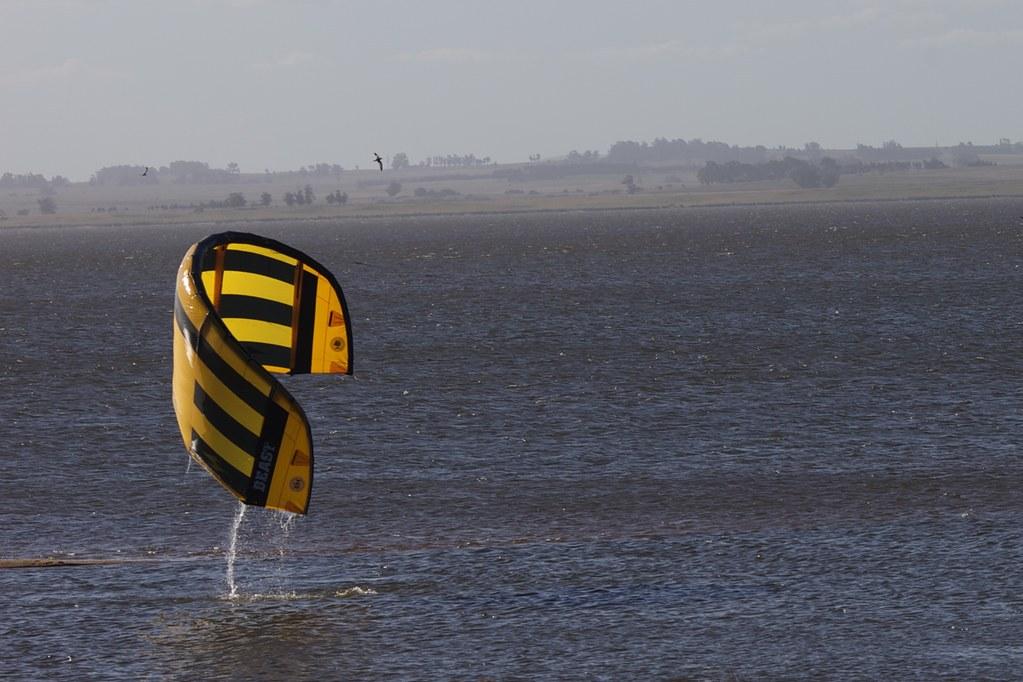
To kitesurf on Laguna Garzón you have to register your session before you start, through the website of Uruguay's Ministry of Environment (ambiente.gub.uy/kitesurf), and stay inside the two permitted zones that use the circular bridge as their axis — one north of it, one south. The cap is up to 30 riders in the water at the same time per zone, and the designated parking areas sit on either side of the bridge's west and east approaches. The best wind window on the lagoon runs from October to March, so the season is about to open: worth sorting out the paperwork before the first good day.
Why the lagoon has rules of its own. Laguna Garzón has been part of Uruguay's National System of Protected Areas since 2014, and the stretch of water with the best kiting conditions is also a critical part of the ecosystem: it concentrates water and shore birds, fish and invertebrates, and it is where the lagoon exchanges water with the ocean when the sandbar opens. So the Ministry did not ban the sport — it organised it in space. The framework was set by ministerial resolution 461/2020, dated December 15, 2020, and extended by resolution 382/2022 until the area's management plan is approved; that plan is still being drafted. Because it is an extended regime rather than a settled one, the sensible move is to confirm the current status on the Ministry's website before each season.
Where you can ride. The permitted zones are laid out around the circular bridge over Laguna Garzón, both north and south of the span. Outside those areas the water is left to the wildlife. The exact boundaries are on the map the Ministry itself publishes, and that map is the thing to check before you rig: it is the official delimitation, not a rough sketch. Designated parking is on both sides of the west and east approaches to the bridge, and there is a practical reason to use it beyond the paperwork — parking off the marked spots speeds up erosion of the sandy banks.
What the cap means in practice. Thirty riders at once per zone is generous for almost any day of the year, but it stops being generous at the January and February peak, when the lagoon fills with kites. The registration requirement exists precisely so the cap can be counted: logging the start and the end of your session is what makes it possible to know how many people are on the water at any moment. If you go with a school, the operator will usually walk you through it; if you go on your own, the registration is on you.
When the wind blows. According to the portal's listing for Kite Club Uruguay, based right by the bridge, the best wind window runs from October to March, peaking in midsummer, and the area records some 245 windy days a year. What makes this lagoon special is not the strength of the wind but the shape of the water: it is shallow and flat, you can stand up across most of it, and the wind is usable from almost any direction once you are inside the lagoon — which is not the case out on the open ocean. That combination makes it one of the friendliest classrooms in the country for a first lesson, and an easy place to get back on the board after months off.
The schools on the shore. On the lagoon's edge, the Escuela de Kite y Windsurf Laura — run by Laura Moñino, an international IKO instructor, with more than 32 years behind it and the only IKO centre in Uruguay — teaches and rents kitesurf, windsurf, wingfoil, SUP and dinghy gear from its base on Ruta 10. The kite school at Laguna Garzón runs beginner courses, clinics for advanced riders and instructor training. And for something calmer, A Pura Vela, on the Rocha shore, works with catamarans and adds family sailing trips with native flora and fauna spotting. Any of the three will also answer the question of the day: is the wind any good or not.
The other spot: Laguna José Ignacio. A few kilometres west, Laguna José Ignacio — 14 km², on Ruta 10 around kilometre 176 — is the area's other body of water with wind conditions suited to kitesurfing and windsurfing, and the portal's listing describes it as a year-round spot. It is also an important bird area, with flamingos and black-necked swans, so the same rules about keeping your distance from nests and colonies apply there. For the full picture of what there is to do on the water around here, our guide to experiences at Laguna Garzón covers water, air, wine and art, and the kayak and SUP guide covers the paddling side.
What to check before you head out. Three things: the current status of the regime and the zone map on the Ministry of Environment website; the conditions of the day with one of the schools on the shore, who read the local wind for a living; and, if you bring a support boat, the navigation rules for the lagoon, which require life jackets and set exclusion zones near the bridge. With that settled, spring takes care of the rest.
Sources: Uruguay's Ministry of Environment (the Laguna Garzón kitesurf registration page and its briefing on what to know before kitesurfing there, covering zones, cap, parking and ministerial resolutions 461/2020 and 382/2022) and the Intendencia de Maldonado, the departmental government (announcement of the two permitted zones north and south of the bridge), both checked on September 10, 2026 and the links re-checked on October 2, 2026; plus Portal Garzón's own published listings for Kite Club Uruguay, Escuela de Kite y Windsurf Laura, A Pura Vela and Laguna José Ignacio. Cover photo: jikatu (CC BY-SA 2.0).
Spotted an error? Write to hola@portalgarzon.com and we will fix it.