Five places do most of the work when you photograph this stretch of Uruguay's Atlantic coast: the circular bridge over Laguna Garzón, from its walkways and from the rises at either end; the José Ignacio lighthouse, from the top and from the two beaches it divides; the shore of the lagoon, with its birds and still water; the dunes and ocean beaches on the Rocha side; and the hillside vineyards of Pueblo Garzón. The best light is at sunrise and sunset, when the low sun colours water and concrete and the wind tends to ease. The season is set by the subject: whales from July to October, migratory birds in spring and autumn, late sunsets in summer and the Milky Way on any moonless night.
This guide organises those places using what the portal has already published: where each one is, where to frame it from, what time to arrive and which rules apply, because much of this landscape sits inside a protected area. You do not need professional gear. Almost everything below can be done with a phone, some patience and an early alarm.
The circular bridge: the classic shot and the others
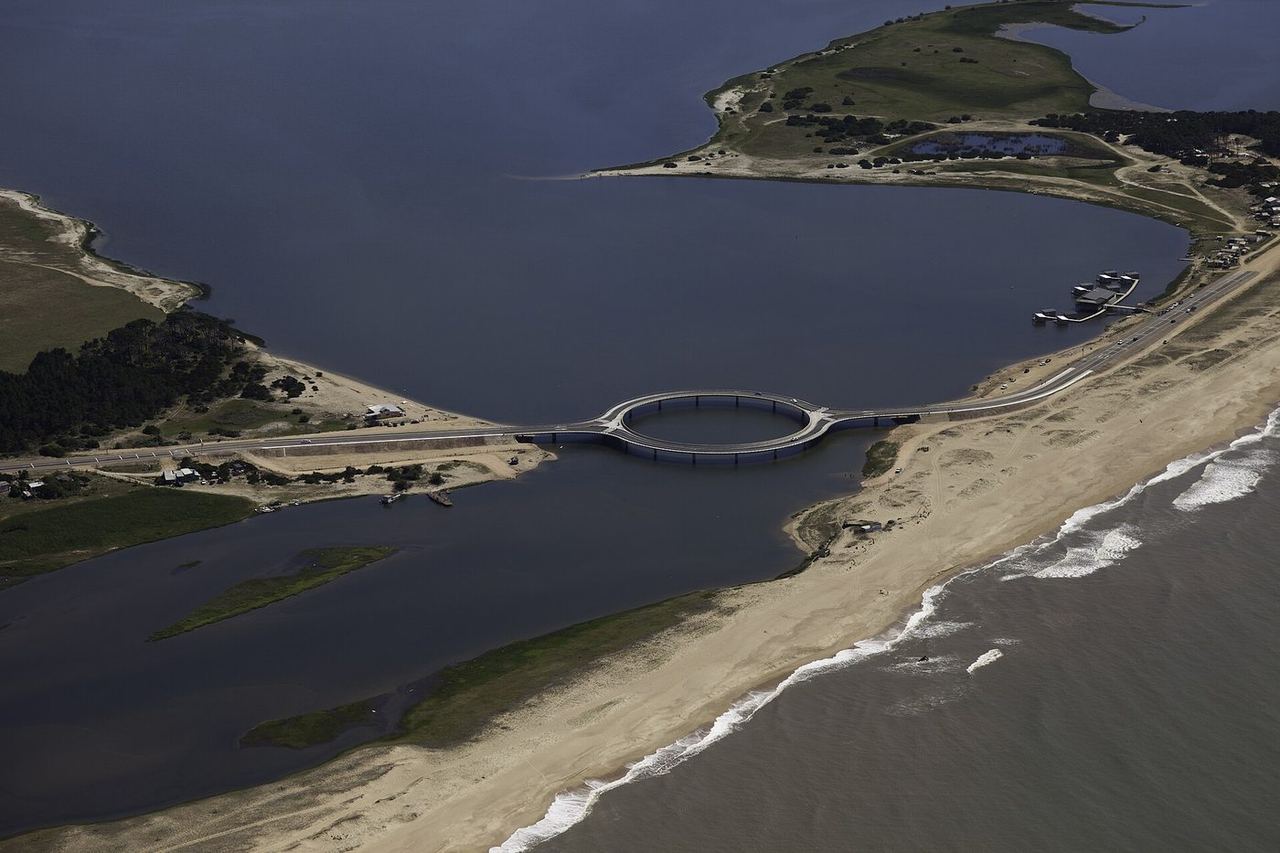
The circular bridge over Laguna Garzón is the most photographed subject on this coast, and it has a rare advantage: you can walk the whole thing. It is about 202 metres of circular roadway resting on 16 round concrete piers, with a pedestrian walkway on both sides of the road; the full loop, with stops, takes 15 to 30 minutes. The bridge walkways give you the close-ups: the curve of the ring disappearing into the water, the repeating piers, the large open circle of lagoon left in the middle and, with luck, black-necked swans or herons crossing it.
The aerial view of the complete circle, the one on every postcard, comes from drones and from the rises at either end of the bridge, where the ground climbs above Ruta 10. For sunset, the best section is the part of the ring that faces west: the low light comes straight in across the water and the concrete. Arrive 30 to 40 minutes before sunset to pick your spot without rushing. Two practical notes: park on the flat areas and shoulders next to the bridgeheads, never on the road or on the ring itself, and there is almost always wind over the water, so hold the camera steady and bring a jacket even in summer.
The José Ignacio lighthouse and its two beaches
The lighthouse, first lit in 1877, stands on the rocky tip of the peninsula and splits José Ignacio into two beaches of opposite temperament. That geometry is a gift for photographers: Playa Brava lies to the east and catches the sun rising out of the ocean; Playa Mansa lies to the west and is where the sun sets over the water, with the whole village turning gold. Both beaches, with their conditions and lifeguard season, are described in the listing for the Brava, Mansa and La Juanita beaches.
When it is open to the public, the climb up the José Ignacio lighthouse is 150 steps to the widest panorama on this coast: the low-rise village with its sand streets, the lagoons and the open Atlantic across almost 180 degrees. It is gusty at the top, so keep the camera strap around your neck. Opening hours change with the season and with the Navy, which operates the lighthouse, so check before you go. From below, the profile of the lighthouse with the rocky points and the surf of Playa Brava is the most repeated image of the resort, and it works best in the raking light of the first and last hour of the day.
The lagoon and its birds: distance, low light and patience
Laguna Garzón is a sheet of water of about 1,750 hectares with an average depth of just 0.46 metres: shallow, calm and without waves. On windless days that means near-perfect reflections of the sky, the bridge piers and the birds. The resident species can be seen from the shore all year and are large and fairly tolerant, which makes them a rewarding first subject: the neotropic cormorant perched on a post with its wings spread, the great egret standing still at the water's edge, the cocoi heron in slow flight, black-necked and coscoroba swans on the mirror of the water, coots among the reeds. The beginner's guide to birdwatching at the lagoon explains how to recognise them and when to go out.
The same hours apply to birds as to landscape: early morning and sunset, when they are most active and the wind is usually lighter. A telephoto lens helps but is not essential. With a phone you work the landscape with birds in it rather than the portrait of a bird. What is essential is distance. The lagoon has been part of Uruguay's National System of Protected Areas since November 2014, and the rules are few and clear: do not approach nests or colonies, keep out of exclusion zones, avoid loud noise and leave no litter. The best wildlife photo is the one the animal never notices. If you would rather go with a guide, the nature-photography outings at Laguna Garzón last two to three hours, adapt to any level and any equipment, phones included, and can be combined with a boat ride for angles from the water. The guided walks through the protected area, about 5 kilometres in two hours, reach native trails you would not find on your own.
West of the village there is another body of water with a different subject: Laguna José Ignacio, 14 square kilometres between km 176 and 179 of Ruta 10, with flamingos and black-necked swans. And on windy days, which ruin the reflections, there is a different picture altogether: kitesurfing on Laguna Garzón, with coloured kites cut out against the sky over the shallow water.
The Rocha side: dunes, sandbar and La Playita
Across the bridge the landscape changes abruptly. The lagoon is separated from the ocean by a sandbar about 3.5 kilometres long, and between km 190 and 198 of Ruta 10 come the ocean beaches of El Caracol, Costa Bonita and El Bonete: long sand, dunes, native scrub and very few people. This is the stretch for wide shots, with the surf line and footprints in the sand as the only references. All of it lies within the protected area: no camping, no fires and no vehicles on the dunes, and the rules of use are available at the Laguna Garzón visitor centre.
On the lagoon itself, near km 193 and about three kilometres from the bridge, La Playita at El Caracol is the best sunset spot on the Rocha shore: fresh, still water, a shallow sandy bottom and the sun going down over the mirror of the lagoon. It is also the base for the horseback rides around Laguna Garzón, which set out from there and offer the picture of horses and riders silhouetted against the last light, on the sand or along the shore. Before the bridge, on the Maldonado side, La Juanita adds another register: wooden houses among pine woods, dunes and dirt roads, a forest landscape that contrasts with the open coast.
Pueblo Garzón: vineyards, square and railway station
Less than an hour inland from the coast, Pueblo Garzón swaps water for land. The stony hillside vineyards of Bodega Garzón define the landscape and are the most photographed rural subject in inland Maldonado: rows of vines following the roll of the terrain, olive groves and hills behind, with the sidelight of late afternoon picking out every furrow. The guided visit includes a walk through the vineyard, the part that yields the most photos, though it is dropped in the rain. In the village, Plaza Artigas and the old railway station hold the rest: the chapel, the social club, unpaved dirt streets and the former AFE station, restored in 2023 as a cultural centre with a 700-metre railway trail. Next to the station is La Galerilla, a gallery and studio run by a photographer inside a restored railway carriage, an essential stop for anyone travelling with a camera.
For the shot from height, Cerro Catedral is the highest point in Uruguay at 513 metres, north of Garzón: from the summit you see the whole Sierra de Carapé. It is a half-day outing with no services, so pack water and closed shoes.
The light: hours, seasons and wind
The general rule is the usual one: first and last hour. At midday the light falls vertically, flattens the landscape and pulls harsh glare off the water. At sunrise and sunset the low sun draws the dunes, the piers and the silhouettes, and there is usually less wind at those hours, which gives the lagoon its reflections back. The hours shift a lot with the season: in midwinter the sun sets around six in the evening, and in January and February there is light until after eight. A calm grey day is not a lost one: diffuse light suits portraits and details, and the birds show themselves more calmly.
Each season brings its subject. From July to October southern right whales pass along the coast: you look for them from a high point such as the lighthouse, on days with little wind and a flat sea, and the first thing you see is the V-shaped blow; the guide to whale watching from the shore explains how to recognise them and which rules apply. Spring and autumn bring the greatest variety of birds, as migratory plovers and sandpipers join the residents. Summer gives the latest sunsets and, in January, the FOCUS festival turns José Ignacio into an open-air photography gallery, with exhibitions in streets, on beaches and in galleries; the dates of each edition are announced through its own channels. And in any season, moonless nights belong to the Milky Way, the Southern Cross and the Magellanic Clouds: the astrotourism guide explains where to find dark skies, away from the lights of the bridge and the centre of José Ignacio, and how to protect your night vision.
From the air and other angles
For the picture nobody else has, the answer is to go up. The paragliding flight over Laguna Garzón takes off from the lagoon, climbs above the coastal woods and scrub, crosses the countryside towards José Ignacio, circles the lighthouse and returns along the beach to the round bridge; sunset flights are the most sought-after. Flights depend on light wind and are arranged by WhatsApp. In José Ignacio, the Ta Khut Skyspace by James Turrell, the only one in South America, offers a different experience of light: a chamber open to the sky that changes at dawn and dusk, open from October to April with a ticket.
One last note on logistics. The best hours are inconvenient ones, and the area is travelled along Ruta 10 with no urban public transport to the bridge. If you are not driving, arrange the trip and the return time with the José Ignacio taxi service, especially for a sunrise. And it gets dark quickly after sunset: bring a torch, or use your phone's, for the walk back to the car.
Practical details
- Circular bridge: Ruta 10, on the Maldonado–Rocha border; 323 m circular section per the MTOP, walkways on both sides; loop on foot in 15–30 min; full circle from the rises at either end
- José Ignacio lighthouse: built 1877, 150 steps when open; Brava to the east (sunrise), Mansa to the west (sunset)
- Lagoon birds: cormorants, herons, black-necked and coscoroba swans, coots and ducks all year; migrants in spring and autumn; always from a distance
- Rocha side: El Caracol, Costa Bonita and El Bonete beaches (km 190–198); La Playita at El Caracol near km 193, sunset over the lagoon
- Pueblo Garzón: Bodega Garzón vineyards, Plaza Artigas, restored AFE station, La Galerilla; Cerro Catedral, 513 m, to the north
- Best light: sunrise and sunset; in winter the sun sets around 6 pm, in January and February after 8 pm
- Seasons: whales July–October; migratory birds spring and autumn; FOCUS in January; Milky Way on moonless nights
- Rules: protected area since 2014: keep your distance from wildlife, no camping, fires or vehicles on the dunes; drones, check first at the visitor centre
- What to bring: windproof jacket, spare battery, a cloth for salt spray, torch, closed shoes for dunes and hills
Frequently asked questions
What is the best place to photograph Laguna Garzón?
The circular bridge on Ruta 10 is the most photographed spot in the area: from the pedestrian walkways you frame the lagoon with the concrete ring in the foreground, and from the rises at either end of the bridge you get the full circle. For the lagoon without the bridge, the public stretches of shore near the sandbar and La Playita at El Caracol, on the Rocha side, give you still water, birds and sunset.
What time of day is best for photographing the Laguna Garzón bridge?
Sunrise and sunset, when low light colours the water and the concrete and the wind usually drops. In midwinter the sun sets around six in the evening; in January and February there is light until after eight. Arrive 30 to 40 minutes before sunset and stand on the section of the ring that faces west.
Can you photograph birds at Laguna Garzón?
Yes, from the shore and all year round. The easiest residents are large and fairly tolerant: neotropic cormorants perched on posts, great and cocoi herons, black-necked and coscoroba swans, coots and ducks. The lagoon has been a protected area since 2014, so the rule is to shoot from a distance, stay away from nests and colonies and keep out of exclusion zones. Guided nature-photography outings adapt to any equipment, phones included.
Which season gives the best photos in the area?
It depends on your subject. From July to October southern right whales pass along the coast and winter light stays low all day. Spring and autumn bring the greatest variety of birds, with migratory plovers and sandpipers. Summer has the latest sunsets and the most stable skies for photographing the Milky Way on moonless nights. No season is a bad one: the subject changes, not the light.
Can you fly a drone over the bridge and the lagoon?
Laguna Garzón and its surroundings have been part of Uruguay's National System of Protected Areas since 2014, with rules meant to keep wildlife undisturbed, and drone flights in Uruguay are subject to their own regulations. Before flying, check the current conditions at the Laguna Garzón visitor centre. Without a drone, the full-circle shot is available from the rises at either end of the bridge or from the air on a paragliding flight.
Sources: pages already published on Portal Garzón about the Laguna Garzón bridge and its walkways, the José Ignacio lighthouse climb, the José Ignacio and Rocha beaches, La Playita at El Caracol, birdwatching and nature-photography outings, Bodega Garzón, Plaza Artigas and the Garzón station, Cerro Catedral, paragliding, the FOCUS festival, whale watching from the shore and astrotourism in the area. Photo: Jimmy Baikovicius (CC BY-SA 2.0). Opening hours, seasons and access conditions are indicative: confirm them before you go.
Spotted an error? Write to hola@portalgarzon.com and we will fix it.